States
Rajasthan’s travelling year turns on night temperature, not on the daytime heat
A dry climate under clear skies loses at night everything it gained at noon, and that swing decides what is comfortable, what is bookable and what is not worth attempting.
By Nadia Haddad4 min read
The Aravalli splits the state before the weather does
The Aravalli range runs on a long diagonal across Rajasthan, roughly from the southwest near Mount Abu up towards Delhi, and it does considerably more work than its worn-down height suggests. Everything to the west of it — Jaisalmer, Barmer, Bikaner, most of Jodhpur district — sits in a genuinely arid zone. Everything east and south of it, the country around Udaipur, Kota and Bharatpur, gets meaningfully more rain and looks like a different state for several months of the year.
That single line explains most of the confusion in trip planning here. People treat Rajasthan as one climate because it is one administrative unit, then find that the fortnight which suits Udaipur perfectly is uncomfortable in Jaisalmer.
The other thing the map hides is elevation. Mount Abu is a hill station in a desert state and behaves like one, cool when the plains are warm and cold enough in midwinter for frost on the grass.
Dry air is a poor blanket
Sand and bare rock take on heat quickly and shed it just as quickly. What keeps a humid coastal night warm is water vapour in the air, which absorbs the heat radiating up from the ground and sends a good share of it back down. Take that vapour away, put a cloudless sky over it, and the ground radiates its heat straight out to space after sunset with nothing to intercept it.
The result is a daily swing that visitors from wetter places consistently underestimate. A midwinter afternoon in the western districts can be genuinely pleasant in a shirt, and the same night can drop towards single figures or below. The gap between the two is often wider than the gap between winter and summer averages in a coastal city.
So the useful number for packing is not the daytime maximum that appears in a forecast headline. It is the minimum, and how long you will be outdoors at either end of the day. Dawn safaris, dune camps and long station platforms all happen at the cold end of that swing.
Winter is the season, and the nights are what it costs
From around November to February the daytime weather in Rajasthan is close to ideal for the kind of travel most people come to do: walking around fort complexes for hours, sitting on rooftops, crossing the state by road. Light is low and long, dust is settled, and the heat that makes the rest of the year difficult is simply absent.
The nights are a different proposition. Desert camps near Sam or Khuri supply quilts because they need to; a canvas tent has essentially no thermal mass and follows the outside temperature down within an hour of sunset. Open-sided jeeps at first light are colder still, because you have added wind to an already cold morning.
None of this is a reason to avoid the season. It is a reason to carry a layer that seems absurd when you pack it in a warm city and turns out to be the most-used item in the bag. A wool hat weighs nothing and changes a January dawn considerably.
March to June is not uniformly impossible
The hot season has a real shape rather than being one undifferentiated wall of heat. March is often excellent, particularly in the first half, with warm afternoons and mild mornings. By the middle of April the western districts are unambiguously hot, and through May and into June the interior regularly runs into the mid-forties Celsius with a dry wind that makes shade less useful than it ought to be.
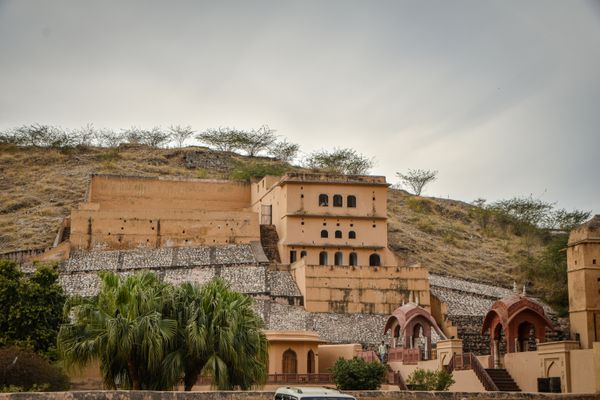
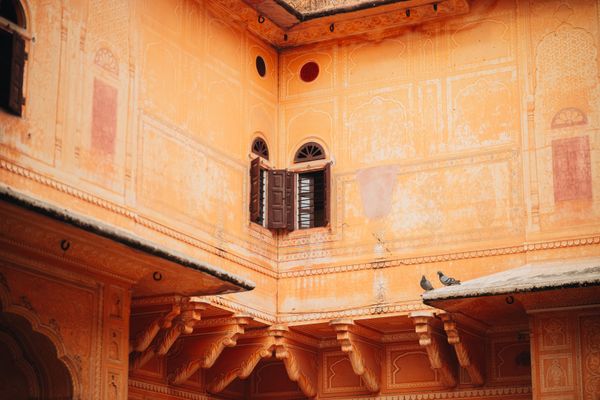
It is dry heat, which is not the consolation people claim it is, though it does change the tactics. Sweat evaporates fast, so you dehydrate quicker while feeling less clammy about it. Stone forts absorb heat all day and release it all evening. There is very little natural shade anywhere in the west, and a courtyard that photographs beautifully at eight in the morning is unusable by eleven.
People do travel in these months, and the reasons are sound: rooms are far cheaper, heritage properties that are booked out in December have space, and the monuments are quiet. It works if the day is built around it — out early, indoors through the middle, out again after five. It does not work if you keep a normal sightseeing schedule and hope.
The crowd concentrates into a few weeks and the price follows it
Demand in Rajasthan is not spread evenly across the good season. It piles into the last week of December, the school holidays around it, the days of a major fair, and the wedding dates that fall through winter and take whole hotels out of general availability. In those windows a room can cost several times what the same room costs in the same month on a quiet Tuesday.
The weeks either side are the useful ones. Late October and early November once the rains have gone, and much of February, give you the same walking weather with a fraction of the competition for it. February nights are already softening too, which for anyone who found the December cold unwelcome is a straightforward improvement.
One practical note that has nothing to do with weather. Distances here are long and the interesting places are strung far apart, so the state punishes tight itineraries more than most. A day of driving between two forts is a day of driving, whatever the season, and it is worth deciding honestly how many of those a trip can absorb.
Common questions
Is a desert camp worth doing in the cold months?
Yes, and the cold months are essentially the only sensible ones for it — the same site in May is punishing. Assume the tent will be as cold as the air outside by midnight, ask what bedding is provided rather than hoping, and take the dawn start seriously.
Can Rajasthan be travelled in the monsoon?
It can, and the south and east of the state are genuinely attractive then, with the lakes full and the hills green. Rain in the far west is light and sporadic, so the desert districts stay hot and turn humid, which a lot of people find worse than the dry heat before it.
How far ahead do the good heritage hotels need booking?
For ordinary winter weeks, a few weeks is usually enough. For the last fortnight of December, for fair weeks and for any date that coincides with a heavy wedding season, months rather than weeks — those are the dates where availability disappears first and prices move most.
Contributing editor, Traveology
Nadia writes about states, hills, coast & islands, mostly the parts other people skip and prefers a plain explanation to a clever one.