Trains & Permits
Winter fog rewrites the northern timetable for weeks at a time
A stable, cold, moist layer over the Indo-Gangetic plain slows trains, grounds aircraft and produces delays that compound across the whole network.
By Radhika Iyer4 min read
What forms over the plain in December and January
The fog that settles over northern India in midwinter is largely radiation fog, formed when the ground loses heat rapidly on long clear nights and cools the air immediately above it to the point where its moisture condenses. Calm conditions let that layer sit rather than mix away, and an inversion — warmer air above, colder air below — puts a lid on the whole thing.
The Indo-Gangetic plain is unusually good at producing this. It is flat, it is moist after the irrigation season, it is enclosed to the north by the Himalaya which blocks the air from escaping, and it carries a heavy load of particulates that give water vapour something to condense onto. The result is a shallow layer that can persist for days and extend across several states.
On the worst mornings visibility falls to a few tens of metres and does not lift until the sun has had hours to burn through the inversion, and sometimes it does not lift at all. This is a seasonal certainty rather than an occasional event, and it is planned for by every transport operator in the region.
A railway in fog is a railway running by sight
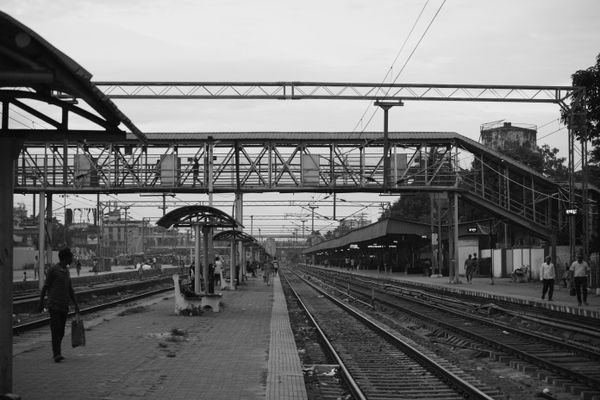
Train movement depends on drivers seeing signals in time to act on them. When visibility drops below the distance needed for that, operating rules require reduced speed and additional precautions, and the whole line slows down accordingly. It is a safety response and it is not negotiable.
A single slow section would be an inconvenience. The problem is that Indian long-distance services run for many hours through exactly the affected region, so the delay accumulates over hundreds of kilometres, and a train that starts an hour behind arrives several hours behind.
Then it compounds. The rake and the crew that arrive late are scheduled to form the return service, so a delay on the inbound leg becomes a delay on the outbound one, and the effect ripples out to trains that never went anywhere near the fog. Operators respond by cancelling or short-terminating certain services for the season, which protects the rest of the timetable at the cost of those particular trains.
Aviation has a harder threshold
Aircraft operations in low visibility depend on the instrument landing capability of the runway, the equipment fitted to the aircraft, and the specific qualification of the crew. Where all three support low-visibility operations, flights continue in conditions that would otherwise stop them; where any one is missing, they do not.
That is why on a foggy morning some flights operate and others are cancelled or diverted at what looks from the terminal like the same moment in the same weather. It is not arbitrary. It is a matter of which combination of runway, aircraft and crew is approved for the visibility that currently exists.
Diversions create their own knock-on effects, since an aircraft that lands somewhere else takes its crew and its next three sectors with it. Delays in the northern winter therefore tend to be network-wide rather than confined to the airport that is actually fogged in.
What this means for a traveller in those weeks
The practical implications are unglamorous but they work. Avoid the earliest departures where the fog is thickest, since late morning and afternoon slots are far more likely to operate close to schedule. Do not connect anything tightly, and above all do not plan a domestic leg into an international departure on the same day.
Track the actual running of a train rather than its timetable. Live running information will tell you where the service actually is, and on a bad morning the difference between the scheduled and the real arrival time at your boarding station can be many hours. Turning up at the scheduled time and waiting on a cold platform is the avoidable part.
Dress for the wait as much as for the journey. A December night on a northern platform is genuinely cold, and the delay you are absorbing was created by the same conditions that make standing around unpleasant.
The season has a shape
Fog builds as winter deepens, is at its worst in the coldest weeks of December and January, and eases through February as nights shorten and the ground stops cooling so far. The exact severity varies year to year with wind patterns, moisture and the passage of weather systems across the north.
It also has a geography. The plains from Punjab across to Bihar are the core of it, while the coasts, the peninsula and the higher ground are largely unaffected. A journey that stays south of the belt is a normal journey in a normal season.
None of this makes winter a bad time to travel in northern India, and the days between the fogs are among the most pleasant of the year — clear, cool and bright. It makes it a season to build a plan with slack in it, and to treat the timetable as an aspiration during the coldest weeks.
Common questions
Are trains cancelled because of fog?
Some are, seasonally and in advance, as a deliberate measure to keep the rest of the timetable workable. Others simply run very late. Both possibilities are worth checking a day or two before travel rather than on the morning itself.
Which is more reliable in fog, the train or the plane?
Neither is dependable, and they fail differently. A train usually still runs but arrives many hours late; a flight either operates broadly on time or does not operate at all. If arriving matters more than arriving on schedule, the train is the safer bet.
Does the fog affect the whole country?
No. It is concentrated over the northern plains, where flat terrain, winter moisture and the barrier of the Himalaya combine to hold the layer in place. The peninsula, the coasts and the hills above the inversion are generally clear.
Reporter, Traveology
Radhika has written about states, hills, coast & islands for most of the last decade and is happiest when a piece answers the question completely.