Festivals
Durga Puja turns Kolkata into a walking city for several nights
Neighbourhood pavilions, closed roads and crowds that move on foot until dawn make the festival week a completely different city from the one on the map.
By Radhika Iyer4 min read
A festival built out of temporary architecture
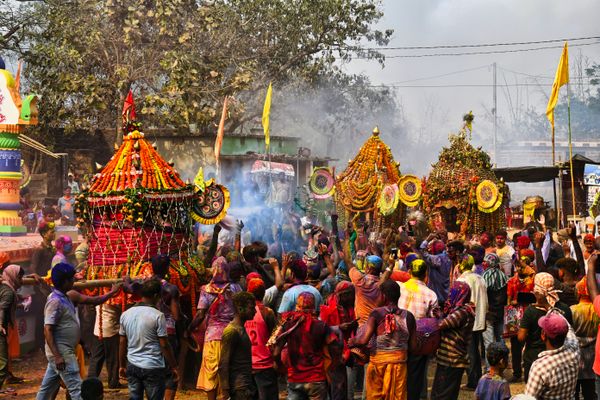
For several days in autumn, neighbourhoods across Kolkata put up pandals — large temporary pavilions, built on frames and clad in whatever the year’s design calls for, housing images of the goddess. They are financed by local committees, sponsored by businesses, designed by artists and judged competitively, and they occupy streets, parks and any open ground a locality can claim.
Some are conventional and devotional. Others are ambitious pieces of installation art on themes that have nothing obviously to do with worship, and the annual competition between committees pushes the scale and inventiveness up every year. The whole apparatus is dismantled within days of the festival ending.
The images themselves are made in the potters’ quarter over the preceding months and are immersed in the river at the end of the festival, which is its own set of processions and its own kind of spectacle. The temporariness is not incidental; the fact that all of it is made to be taken apart is part of what the festival is.
The crowd moves on foot, all night
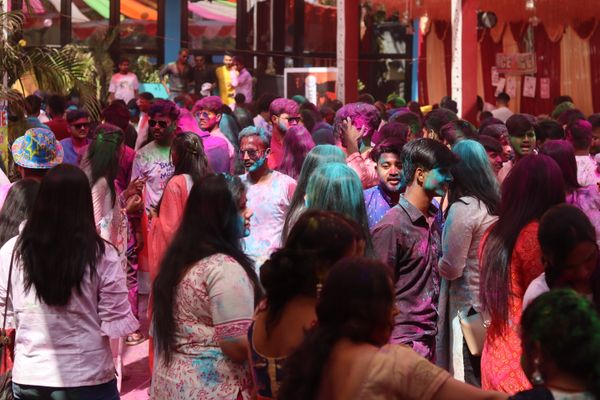
The central practice for most people is pandal hopping: walking a circuit of pavilions across a night, often continuing until the early hours, in a crowd dense enough that traffic is simply not an option. Police close roads and impose one-way pedestrian flows in the busiest areas, and buses and taxis are diverted or become useless.
Public transport in the city typically runs extended hours through the peak nights, with the arrangements announced each year, and the network is the practical way to cross town between clusters of pandals. Beyond that the answer is walking, and a lot of it — several kilometres across a night is normal rather than exceptional.
This changes the physics of a visit completely. Plans built around being driven from place to place do not survive contact with the festival, and anyone who cannot walk long distances in a dense crowd should think carefully about which nights to be out and where.
The peak nights are not the whole festival
The festival has a structure, running over several days with a rising intensity towards the final ones, and the crowd follows that structure closely. The last few nights are the crush; the earlier days are busy but manageable, and many pandals are complete and open before the official peak.
For a visitor who wants to see the work rather than experience the crowd, the days before the peak are a genuinely different and easier proposition. Photographers and people with an interest in the design go early, when it is possible to stand in front of a pavilion and look at it.
The final day and the immersion processions are the other end of the experience and are worth seeing precisely because they are not tidy. It is not a spectacle staged for visitors; it is a very large number of people doing something that matters to them, and the appropriate posture is that of a guest.
What the city is like to stay in that week
Accommodation is booked far in advance and priced accordingly, and the closer to the busy pandal clusters you are, the harder it is to arrive and leave by vehicle. Staying slightly outside the densest areas and using the rail network inward is usually more practical than trying to be in the middle of it.
Ordinary business hours dissolve. Offices close for the main days, many shops shut or work erratic hours, and the ordinary sightseeing city — museums, institutions, the usual list — is largely unavailable. Eating, on the other hand, becomes a round-the-clock activity, since the whole city is out and the whole city is hungry.
Getting into or out of Kolkata during those days is its own problem. Trains and flights fill for weeks around the festival because a large number of people travel home for it, so book the arrival and the departure long before you think about the rest.
Whether to be there for it
If crowds are something you tolerate rather than enjoy, the honest answer may be to visit Kolkata at another time. The city has a great deal to offer in the cool, quiet weeks of winter, and none of it is accessible in the same way during the festival.
If, on the other hand, the appeal is a city collectively doing something extraordinary, there are few better examples anywhere. The design, the scale, the all-night movement of people and the fact that it is entirely locally organised rather than institutionally produced make it a particular kind of experience.
The middle path, which a lot of experienced visitors take, is to arrive before the peak, see the pandals while they can still be looked at, spend one of the big nights out in the crowd deliberately, and leave the last day to the city itself.
Common questions
When exactly does it fall?
In autumn, on dates set by the lunar calendar, which means they shift by up to several weeks from year to year. Check the dates for your specific year well before booking, because the surrounding travel demand builds around them rather than around the month.
Is it appropriate for visitors to go inside the pandals?
Generally yes — the pavilions are public and visitors are common. Behave as you would at any place of worship: dress modestly, follow whatever queue system is in place, ask before photographing people rather than structures, and keep out of the way during rituals.
Can the city be seen normally during the festival?
Not really. Many ordinary institutions are closed, traffic is diverted and the streets belong to the festival. A trip that wants both the festival and the conventional city should allow days on either side of the peak.
Reporter, Traveology
Radhika has written about states, hills, coast & islands for most of the last decade and is happiest when a piece answers the question completely.