States
In dry western India the water building came before the palace
Stepwells, tanks and reservoirs were the expensive infrastructure of an arid region, which is why they are architecturally serious and why the fort above them stands where it does.
By Sofia Almeida4 min read
A settlement in a dry region is a water decision first
Across Rajasthan, Gujarat and the drier parts of the Deccan, rain arrives in a short, violent burst and then stops for eight or nine months. Nothing about that pattern is friendly to a town. The problem was never the annual total, which in many of these districts is respectable enough on paper; the problem was that all of it fell in a few weeks and then ran away downhill.
So the founding question for any large settlement here was not defence or trade. It was whether the site could hold enough of that brief rainfall to get several thousand people through to the following June.
Once you start looking at old towns through that lens, the layout stops being arbitrary. The fort sits above the water, the temple sits beside it, and the oldest quarter of the town wraps around whichever tank or well was reliable. The order of construction is often the reverse of what a visitor assumes.
A stepwell is a building that follows the water table down
The stepwell — vav in Gujarat, baoli or bawdi across much of the north — solves a specific problem. A rope-and-bucket well gives you water but nothing else; a stepwell gives you access on foot to whatever level the water has fallen to, which in a region where the table drops steadily through the dry season is the whole point.
That requirement produces the strange, inverted architecture these places are famous for. The structure is a descending corridor of steps with landings and colonnades at intervals, built downwards through the earth rather than upwards from it, and it grows more elaborate the further from daylight you go.
The famous ones are famous for good reason. Rani ki Vav at Patan is a UNESCO-listed monument and reads more like a subterranean temple than a well; Adalaj near Ahmedabad and Chand Baori at Abhaneri in Rajasthan are among the other well-known examples. But there are hundreds of smaller ones in villages, most unlisted, many silted up or fenced off.
They were social buildings as much as hydraulic ones
A stepwell is cool. Not pleasantly shaded — genuinely several degrees cooler than the surface, because you have descended into the ground and put a great deal of stone between yourself and the sun. In a landscape with almost no natural shade that is a resource in itself, and the pavilions built into the descent were used accordingly.
Fetching water was overwhelmingly women’s work, and the stepwell was therefore one of the few large public spaces in which women assembled daily without the visit needing any other justification. A number of the surviving structures were commissioned by women, and the inscriptions say so.
This is why the carving matters. A pure engineering solution wouldn’t have needed any of it. The decoration is evidence that these were understood as public buildings, endowed the way a temple or a rest house was endowed, and the endowment was an act of merit as much as of civil administration.
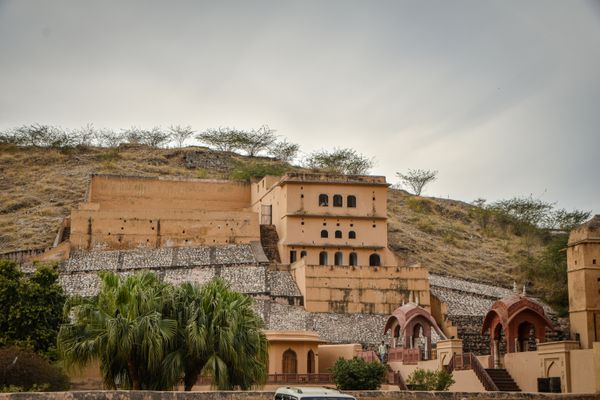
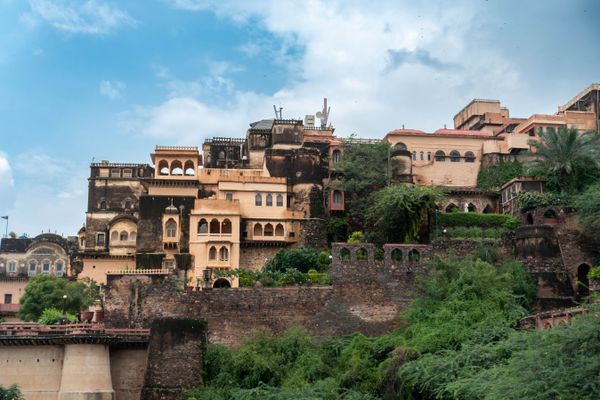
The fort on the ridge is usually attached to a water system
Hill forts look self-sufficient and mostly were not. A besieged garrison on a rock has whatever water the rock holds, so the serious forts were built around reservoirs, cut cisterns and channels that collected runoff from the bare stone slopes and directed it into tanks inside the walls.
Jaisalmer and Jodhpur both sit near constructed lakes and tank systems built to serve them, and Chittorgarh’s plateau holds a series of reservoirs rather than one. At Golconda the water was lifted mechanically to serve the upper works. The details differ; the logic doesn’t.
If a fort you are visiting seems to have no water story, it’s usually because the tanks are dry, unlabelled and off the visitor route rather than because they never existed. Asking a guide where the water came from is one of the more productive questions available at these sites, and it is rarely on the standard script.
Most of them are unmanaged, and that decides how you visit
The headline monuments have tickets, timings and guards. Everything else is somewhere on a spectrum between a protected monument and an abandoned hole in the ground, and the condition varies enormously — some are maintained by a village trust, some are choked with rubbish, some have been restored recently and beautifully, and a good number are locked because an unfenced stepwell is a genuine hazard.
Practical consequences follow. Steps are uneven and frequently wet; there are usually no handrails; bats, bees and standing water are all normal. Photographers turn up at midday for the geometry and get the harshest possible light, when early morning gives the same shapes with something in the shadows.
Access rules at any specific site change with restoration work and local decisions, so the current official position is worth checking rather than assuming. The broader point stands whatever the gate says. These are the most sophisticated buildings many of these towns ever produced, and they were built to solve the same problem the region still has.
Common questions
Are stepwells still used for water?
A few are, mostly in villages where the alternative supply is unreliable, but the great majority stopped being working infrastructure once piped supply and borewells arrived. Borewells in particular lowered water tables in many districts, which is one reason so many stepwells now stand dry.
What is the best time of day to visit one?
Early morning or late afternoon. The structures are deep and narrow, so at midday the upper levels are blown out and the lower ones are black, and the geometry that makes them worth seeing disappears into contrast. Cooler hours also mean fewer people on the steps.
Is it worth seeking out the small unlisted ones?
Often yes, if you are already travelling by road in Gujarat or Rajasthan and can ask locally. They are usually empty of visitors and sometimes in daily village use. Treat them as living places rather than ruins, ask before descending, and accept that some will be locked or unsafe.
Deputy editor, Traveology
Sofia writes the explanatory pieces on states, hills, coast & islands and reads the small print so you do not have to.