Coast & Islands
Indian beaches are made of different things and it shows in the sand
Coral, granite, volcanic rock, river silt and mineral deposits all produce shorelines, and what a beach is made of decides its colour, its firmness and how it behaves in the sea.
By Manish Trivedi4 min read
Sand is the ground upstream, broken down and delivered
A beach isn’t a substance in its own right. It is whatever the rock and reef nearby have been reduced to, carried along the shore and dropped where the energy of the water falls low enough to drop it. Change the source and you change the beach entirely.
On most of the Indian mainland the source is the land — rivers bringing weathered material off the Deccan and the Ghats, and waves cutting into headlands. On the coral islands the source is the sea itself, since the sand there is broken skeleton and shell rather than mineral rock from any continent.
That distinction explains the single most obvious difference a traveller notices. The blinding white sand of the Lakshadweep and parts of the Andamans is biological in origin, and no amount of river sediment anywhere on the mainland will ever produce the same colour.
The Konkan coast is red rock and coarse sand
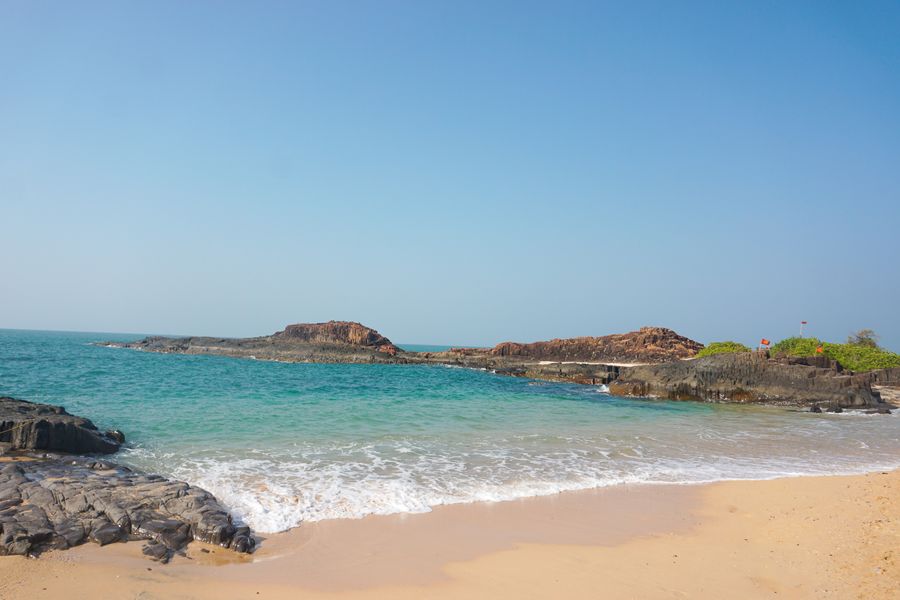
From Maharashtra down through Goa and into coastal Karnataka the dominant material is laterite, a red, iron-rich rock formed by long tropical weathering. It shows up as the flat-topped red plateaus above the shore, the blocks in old walls and the red dust on everything at the end of the dry season.
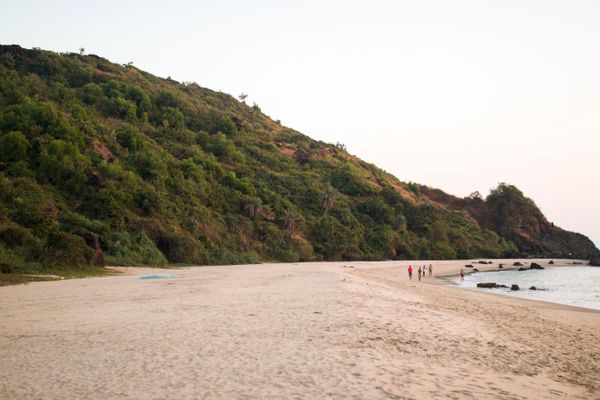
Laterite makes strong headlands, which is why this coast is a repeating sequence of a rocky point, a curved bay with a beach in it, another point, another bay. Each bay is a separate sediment system, which is why two beaches ten minutes apart can differ noticeably in the coarseness and colour of their sand.
The coarser the sand, the steeper the beach face and the more abruptly it drops into the water. That is a physical relationship, not a coincidence, and it is why some of these bays shelve away sharply within a few metres of the waterline while a fine-sand beach elsewhere shallows out for a hundred.
Dark sands and mineral deposits are real, and not pollution
Parts of the Indian coast, notably stretches in Kerala and Tamil Nadu, carry sands that are visibly dark, sometimes almost black, in bands or across whole beaches. The colour comes from heavy minerals — the dense grains that survive when lighter quartz has been winnowed away by waves and current.
These deposits are commercially significant, and mineral sand extraction operates along some of these coasts, which is a live local issue in places where the same sand is the beach. Visitors sometimes read the dark bands as contamination. They are usually geology doing what it does.
The practical effect is that dark sand gets far hotter underfoot in the sun than pale sand does, for the obvious reason. On a mineral-rich beach at midday the walk from shade to water is a genuinely different experience from the same walk on a white one.
Deltas and estuaries make mud rather than beaches
Where a large river reaches the sea, the material arriving is fine — silt and clay rather than sand — and the result is not a beach at all. The Bengal and Godavari-Krishna delta shores, the Gulf of Kachchh and long stretches of the Gujarat coast are mudflat, marsh and mangrove rather than anything a swimmer would recognise.
These are among the most biologically productive coasts in the country and among the least suited to the standard beach holiday. Firm sand near a river mouth may be a thin skin over soft ground, currents at the mouth itself are strong, and the water carries the sediment that gives it its colour.
It is worth knowing which kind of coast a destination sits on before booking a beach stay near a delta. A lot of disappointment on the eastern seaboard comes down to expecting Goa’s geology in a place the Ganga or the Godavari has been building for millennia.
Cliffs, laterite terraces and the shores with no sand
Some of the most striking coastline in India has very little beach on it. Varkala in Kerala is a well-known example, where the shore is a line of cliffs with a narrow strand at the bottom, and much of the Konkan alternates cliff and bay in the same way.
A cliffed shore behaves differently in the sea. There is less sand to absorb wave energy, the water can be deep close in, and rock platforms exposed at low tide are sharp, slippery and occupied by sea urchins in places. The photographs are excellent and the swimming is often not.
The general point is worth carrying around the coast. Before assuming a shoreline will suit a particular activity, it helps to ask what the ground is made of — coral, laterite, granite, mineral sand or river mud — because that answer predicts the colour, the slope, the temperature underfoot and what the sea does when it arrives.
Common questions
Why is island sand so much whiter than mainland sand?
Because it has a different origin. Coral island sand is made of broken coral, shell and the skeletons of reef organisms, which are pale calcium carbonate. Mainland sand comes from weathered continental rock and carries iron and other minerals that tint it yellow, grey, red or black.
Is black sand safe to walk on and sit on?
Generally yes — it is mineral sand rather than anything contaminating. The one real caution is heat, since dark sand absorbs far more sunlight and can become painfully hot in the middle of the day. Footwear from the shade to the water is a sensible habit on those beaches.
Why do some beaches drop off steeply and others stay shallow?
Grain size. Coarse sand and shingle drain quickly and pile into a steep face, so the beach falls away sharply into the water. Fine sand holds water and forms a very gentle slope, which is why fine-sand beaches shallow out slowly and coarse ones can be over your head within a few steps.
Consumer editor, Traveology
Manish covers states, hills, coast & islands and the questions readers actually send in and reads the small print so you do not have to.