Coast & Islands
Sea air is slowly taking apart India’s shore monuments
Salt spray, wind-driven sand and a permanently damp atmosphere attack coastal stone in ways that inland weathering does not, which is why a temple by the sea looks older than one of the same age inland.
By Pranav Kulkarni3 min read
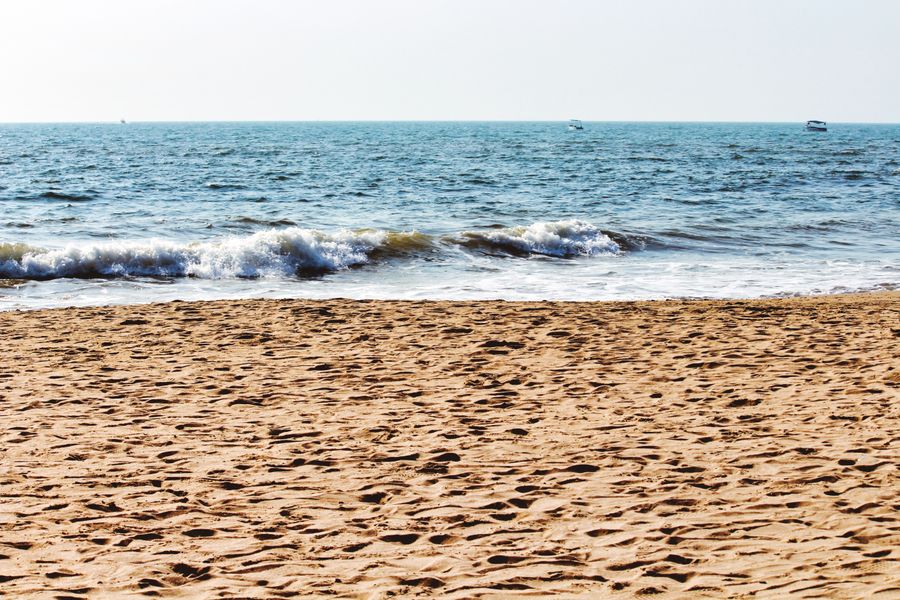
Salt reaches a good deal further inland than the beach
Waves throw up fine droplets, wind carries them, and the salt in them is deposited on every surface downwind. On an exposed coast measurable amounts of sea salt reach structures well back from the shoreline, and anything standing in that airstream is receiving a continuous light dusting of it.
Stone is porous, so the salt does not stay on the surface. Dew, humidity and rain dissolve it and draw the solution into the pores, and the whole cycle repeats every time the surface wets and dries.
This is why coastal buildings decay in a pattern that has little to do with age. Two structures built in the same century, one on the shore and one twenty kilometres inland, will be in visibly different condition, and the difference is chemistry rather than neglect.
The damage is done by crystals growing inside the stone
When a salt solution inside a pore dries out, the salt crystallises, and the growing crystal exerts pressure on the surrounding stone. One cycle does nothing. Thousands of cycles, repeated daily as humidity rises and falls, break the surface apart grain by grain.
The visible result is a stone face that is powdering, flaking off in thin sheets, or hollowed out behind a hard outer skin. Carved detail goes first, because it presents more surface to the air and because thin projecting elements have nowhere to shed the stress.
Different stones resist differently. Granite is dense and relatively resistant, though it is not immune where the surface has weathered; sandstone and laterite are porous and suffer badly. It is a mistake to assume that a heavily eroded coastal sculpture must be far older than a sharp inland one.
Wind-blown sand is the second instrument
On a beach with a strong prevailing wind, sand travels close to the ground and abrades whatever it meets. The effect is concentrated in the lower part of a structure, which is why the base of a shore temple is often noticeably more worn than the parts above head height.
Sand also buries. Several shore monuments have spent long periods partly covered in dune sand, and although burial is destructive in its own ways it also protects a surface from spray and abrasion, so the buried portions sometimes emerge in better condition than what stood above.
Storm events do in hours what the ordinary process does in decades. A cyclone that drives salt water and debris against a monument can strip surfaces and undermine foundations, and the coasts most exposed to those storms are the ones where conservation is a continuous effort.
What has been tried, and what is argued about
The most visible intervention is planting. Windbreaks of hardy trees have been established around several exposed sites to slow the wind and intercept spray before it reaches the stone, and at Mahabalipuram this approach has been used around the shore temple for a long time.
Hard defences — sea walls, groynes, rock armour — protect the ground the monument stands on, at the cost of changing how sand moves along that stretch of coast, which frequently shifts the erosion somewhere else. Chemical consolidants and water-repellent coatings have also been used, and their long-term effects on porous stone are genuinely disputed among conservators.
The honest summary is that nothing stops the process; the work is about slowing it and about recording what is there. Documentation, in that light, is a form of conservation, and it is one reason photography rules at some sites are stricter than visitors expect.
Looking at a weathered monument properly
It’s worth separating three things that look alike from a distance: deliberate unfinished work, deliberate damage from a much older conflict, and slow environmental decay. The first has tool marks and a clear logic, the second is usually concentrated on figures, and the third is even, granular and worst where the wind hits.
Touching accelerates all of it. Skin leaves salts and oils on stone that is already fighting a salt problem, and a carved surface that thousands of hands rest on wears in a way that is easy to see once you notice it.
Visit early. Low sun across a weathered surface reveals detail that flat midday light erases completely, the sites are cooler, and the sea wind has usually not yet got up. Rules on tripods, drones and access to particular structures are set by the managing authority and do change, so check the position for that site on the day.
Common questions
Why do some coastal temples look ruined and others do not?
Exposure, stone type and how much intervention there has been. A structure sheltered by dunes or by a headland, built in dense granite, and maintained continuously can look centuries younger than a porous sandstone building standing in the open wind a short distance away.
Does the sea actually reclaim monuments?
It has done, along coasts that are eroding, and the loss of shoreline over long periods has taken structures with it. Claims about specific submerged sites vary from well-evidenced to speculative, so it is worth distinguishing archaeological findings from the more colourful accounts that circulate around them.
Is it better to see these places in the monsoon or the dry season?
The dry months are more comfortable and the light is better, though the sites are busier. Wet weather brings the atmosphere that photographs well and also the conditions in which stone surfaces are most fragile, so the ordinary courtesies about staying off structures matter more then, not less.
Editor, Traveology
Pranav writes the explanatory pieces on states, hills, coast & islands and reads the small print so you do not have to.