Trains & Permits
An itinerary for elderly parents is built around fewer bases, not fewer sights
Most of the difficulty in travelling with older relatives in India comes from the moving rather than the seeing, which means the fix is structural and can be made without cutting the trip down to nothing.
By Nadia Haddad3 min read
The itinerary is the decision that matters most
Almost everything that goes wrong on a trip with older parents is a consequence of too many changes: another packing, another checkout, another vehicle, another unfamiliar bathroom, another night in a different bed. The sightseeing is rarely the exhausting part.
A trip built around three bases with day trips out of each is a different physical proposition from the same route taken as seven one-night stops, even though the map looks similar and the list of places seen is nearly identical.
The second structural decision is the length of the travelling day. A five-hour drive that begins at nine and ends in the afternoon leaves the evening intact; the same distance begun at two in the afternoon eats the day at both ends and arrives in the dark.
What the railways can be asked for
The railway system has a set of provisions for senior citizens and for passengers with disabilities, including berth allocation preferences and category quotas at booking, and these are worth using rather than hoping for a lower berth on the day.
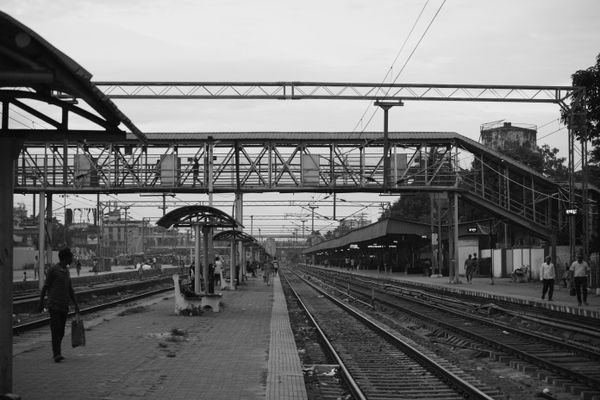
Larger stations have wheelchairs and, at some, battery-operated vehicles to cover the long distances between entrance and platform, along with lifts or ramps at the footbridges. Availability differs enormously between a major junction and a small station, and it is normally arranged by asking the station staff in advance rather than on arrival.
What exists, what has to be requested ahead and what is charged for changes over time and is not identical at every station, so the reliable approach is to contact the station or the railway’s passenger helpline for the specific journey rather than to rely on general advice.
Temples, forts and long flights of stairs
A great many of India’s best sites involve stairs, uneven stone and long distances on foot, and some involve standing barefoot on ground that is hot enough to be genuinely painful in the middle of the day. None of that is negotiable, so the timing is what has to change: early morning, and a slow pace.
Several major temples operate separate or assisted queues for elderly and disabled pilgrims, and some hill shrines have arrangements for being carried or for a mechanised ascent. These vary by site, sometimes require documentation, and are frequently oversubscribed, so they need to be looked into for the particular shrine well before arriving.
It is also entirely reasonable to see less of a site. Walking the outer courtyard of a fort and sitting somewhere with a view while others climb is not a failure, and building that possibility into the day removes the pressure that makes people push past their limit.
Medicines, heat and the small logistics
Regular medication belongs in hand luggage, in its original packaging, with a written list that includes generic names rather than brand names, since the brands available in an Indian pharmacy will often be different. A copy of recent prescriptions is worth carrying and takes up no space.
Pharmacies are widespread and hospitals in district towns are more capable than visitors expect, but the useful piece of preparation is knowing where the nearest reasonable hospital is for each base you are staying at. Any travel insurance position should be checked and understood before departure rather than at the point of need.
Heat and dehydration are the most common underlying cause of a bad afternoon, and older travellers often feel thirst later than they should. Scheduled water, shade in the middle of the day and a lighter afternoon are more effective than any amount of encouragement.
Young children change a different set of variables
Small children make short journeys harder and long ones easier than people expect, because a train allows movement and floor space in a way a car does not. Night travel by train can work well simply because the child sleeps through it.
The supply side is generally good: nappies, formula, bottled water and children’s medicines are available in any town of size, and Indian public life is broadly welcoming of children in a way that removes a lot of the friction familiar elsewhere. Child seats in hired vehicles are the notable gap, and cannot be assumed.
The genuine constraint is altitude. Both very young children and older adults with heart or lung conditions are at real risk on high mountain roads, and medical advice specific to the person is the right basis for that decision. This is one of the few points in Indian travel where the sensible answer may be to choose a different destination entirely.
Common questions
Is it worth hiring a car with a driver rather than using trains?
For part of a trip, often yes, because door-to-door removes the two hardest moments of any rail journey — reaching the platform and getting off it. Over very long distances a train is usually kinder, so the strongest itineraries mix the two rather than committing to either.
How much walking should be assumed at a major monument?
More than the site plan suggests. Large complexes involve a lot of ground between the entrance and anything else, and the surfaces are uneven. Ask at the ticket office how far the walk is and whether any vehicle operates inside, since several of the biggest sites do run one.
What about wheelchair access generally?
It is improving at airports, at newer stations and at some major monuments, and it remains inconsistent everywhere else. Assume that assistance will be available with notice and that step-free routes will not, and check the specific sites and stations on the route rather than the country as a whole.
Contributing editor, Traveology
Nadia writes about states, hills, coast & islands, mostly the parts other people skip and prefers a plain explanation to a clever one.