Festivals
Ramlila is weeks of street theatre that end in ten minutes of fire
The north Indian enactment of the Ramayana runs in nightly instalments across a town, performed largely by amateurs, and the effigy burning everybody photographs is only its final scene.
By Nadia Haddad4 min read
A play performed in instalments, not in an evening
Ramlila is a dramatisation of the Ramayana staged over a sequence of consecutive nights, usually building towards the day of Dussehra. Each evening covers a section of the narrative, the audience returns for the next, and the whole cycle can run for a week, a fortnight or considerably longer depending on the tradition.
This serial structure changes what the event is. It is not a performance somebody attends once; it is a season in the life of a neighbourhood, with the same families in the same places night after night and children who follow the story better than most visitors will.
The staging is generally open — a temporary platform in a maidan, a street closed for the purpose, a temple courtyard — and the audience sits on the ground around it. There’s no ticket in the ordinary sense at the traditional versions, and there is no separation between the performance and the town it is happening in.
At Ramnagar the town itself is the stage
The best-known version is staged across the river from Varanasi at Ramnagar, and it works on a scale that is hard to convey. Rather than one stage, permanent sites scattered around the town stand for the different places in the story, and the audience walks from location to location as the narrative moves.
The run lasts about a month, the performances are lit largely by lamps rather than by electric stage lighting, and there is no amplification in the traditional staging, which means the crowd falls silent to hear the dialogue. Very large numbers of people move together between sites each evening.
It is an unusual thing to witness even by the standards of Indian festivals, precisely because the audience is inside the production rather than in front of it. Whether the arrangements in any given year match this description is worth confirming locally, since the details of the staging have been adjusted over time.
The cast is the neighbourhood
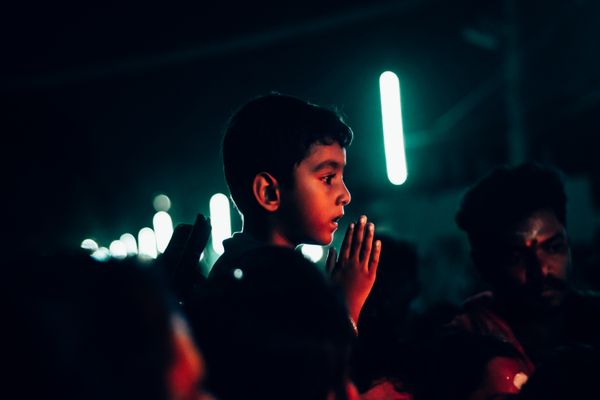
Traditional Ramlila is amateur theatre in the strict sense. The performers come from the locality, the organising committee raises the money from the same streets, and roles are frequently held for years by the same people, with the principal divine roles played by boys chosen for the season.
Those boy performers occupy a genuinely religious position while they are in role, and are treated with the respect due to what they represent rather than as actors. That is the point at which a Western vocabulary of theatre stops being adequate to describe what is going on.
Regional traditions differ considerably. The Ramlila of the Kumaon hills is a musical form with its own repertoire of tunes, and the tradition as a whole has been recognised internationally as an item of intangible cultural heritage. What is performed in Delhi on a large modern stage with a sound system is a descendant of the same practice and a different experience of it.
The last night is the one everybody has seen photographed
On the concluding day, enormous effigies of Ravana and his brother and son are erected in an open ground and burned, usually packed with fireworks so that the destruction is loud and quick. Crowds at the larger grounds in northern cities are very large indeed.
It is worth understanding the sequence to appreciate it. The burning is the resolution of a story the audience has been following for a fortnight, so at a traditional Ramlila it lands as a conclusion, whereas at a municipal event attended for the spectacle alone it is essentially a firework display with a narrative attached.
The safety considerations are real and ordinary: dense crowds, pyrotechnics, and a rush at the end. Arrive early, stand at the edge rather than in the middle, know how you are getting away afterwards, and be aware that traffic around these grounds becomes impossible for a long while after the burning.
Attending one usefully
A neighbourhood Ramlila in a small town is generally a better experience than a large city event, because it is closer to what the form is for and because there is space to sit. Performances start late in the evening and can run well past midnight, so it isn’t a plan for the same day as a long journey.
Nobody will mind an outsider watching, and somebody will very likely explain what is happening if you look interested. Sit where the audience sits, take shoes off if the ground is being treated as sacred, and stand when the crowd stands.
The dates track the same lunar reckoning as Dussehra and therefore move in the Gregorian calendar from year to year. Local committees announce their own schedules, so the practical approach is to ask in the town rather than to look for a national listing.
Common questions
Do you need to know the Ramayana to follow it?
A rough outline helps a great deal, since the performance assumes the audience already knows the story and is watching for the treatment rather than the plot. An hour spent on a summary beforehand converts a confusing evening into a legible one.
Is Ramlila performed everywhere in India?
It is a mainly northern and central tradition, strongest across the Hindi-speaking states and present wherever those communities have settled. Other regions mark the same days in quite different ways, and the south in particular has its own festivals in this period with no theatrical enactment of this kind.
Is the effigy burning worth travelling for on its own?
Less than people expect. It is a few minutes of fire at the end of a long wait in a very large crowd. The theatre over the preceding evenings is the part with substance, and seeing one night of that plus the burning is a better use of a trip than the burning alone.
Contributing editor, Traveology
Nadia writes about states, hills, coast & islands, mostly the parts other people skip and prefers a plain explanation to a clever one.