Coast & Islands
India’s coastal lagoons fill with migratory birds in the cold months
Brackish shallow water behind a sand bar produces exactly the feeding conditions that waterbirds need in winter, which is why the same few lagoons matter far out of proportion to their size.
By Radhika Iyer3 min read
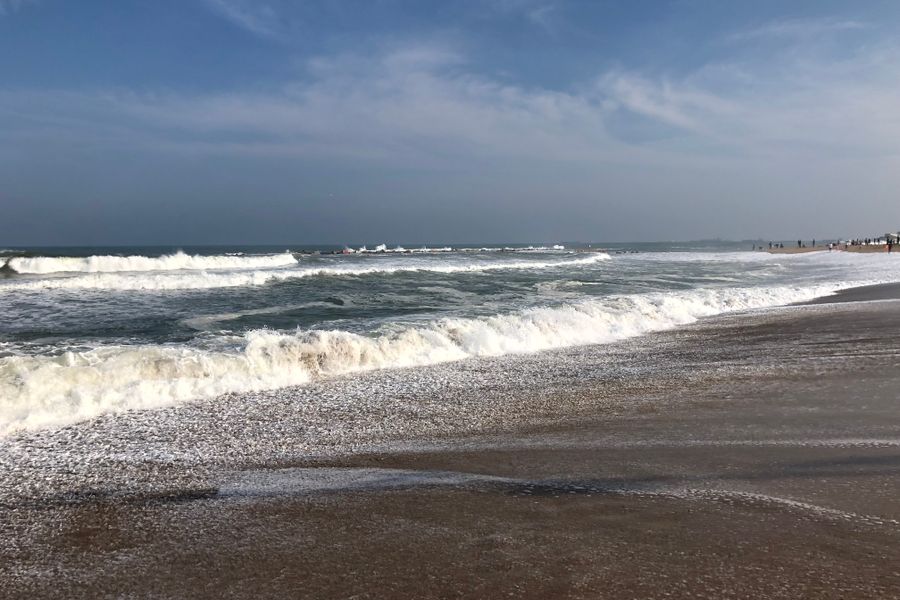
A lagoon is a shallow bowl of mixed water
Several stretches of the Indian coast carry large lagoons, formed where a sand bar or spit has partly closed off a bay and left a broad body of shallow water behind it. Fresh water arrives from rivers at one end and sea water enters through a narrow mouth at the other, which makes the whole system brackish and variable.
Salinity in such a place is not one number. It changes with distance from the mouth, with the season, and dramatically with the monsoon, when river inflow pushes the salt back towards the sea. That gradient supports a wider range of life than either a purely freshwater lake or open sea would.
Shallowness is the other essential quality. Water that a wading bird can stand in, over mud full of invertebrates, with fish concentrated into limited depth, is a feeding ground of unusual productivity. It is why these places support both large bird populations and substantial local fisheries.
The winter arrivals come a very long way
From late autumn, birds that breed across northern Asia move south ahead of the freeze, and a proportion of them winter on the Indian subcontinent. Ducks, waders, flamingos, geese and terns arrive in numbers over a few weeks, and the coastal lagoons are among the places they concentrate.
They are not there for scenery. A wintering bird needs to feed heavily and avoid disturbance, and a shallow productive lagoon with extensive undisturbed margins provides both. Numbers build through the cold months and then fall away in spring as the birds head north again for the breeding season.
The consequence for visitors is a clear seasonal window. Going in the warm months means seeing the lagoon, which is worthwhile, and very little of what makes it internationally significant. The birds are the winter product and they are not there the rest of the year.
Boats, distance and light decide what you actually see
Most lagoon visits are by boat, and the birds are usually distributed in flocks on distant mudflats and shallows rather than close to a jetty. Binoculars change the experience completely, and their absence is the commonest reason people come back disappointed from a trip that was technically successful.
Timing matters as much. Early morning gives calm water, good light and active birds, while the middle of the day is hot, hazy and quiet. Wind gets up in the afternoon on most large lagoons, which makes a small boat uncomfortable and the water surface harder to see across.
Boat operators vary enormously in how they behave around a flock. Driving into the middle of a raft of feeding birds produces a spectacular few seconds and costs the birds energy they cannot spare. It is worth saying at the start that you would rather approach slowly and stop short, and it is worth choosing an operator who agrees.
These are working waters as well as wildlife sites
Indian coastal lagoons support fishing communities that have used them for generations, with a complicated mixture of traditional rights, leases and more recent aquaculture. Any visit passes through a landscape of nets, stakes, embankments and small craft, and none of it is decorative.
The tensions are real. Aquaculture and encroachment reduce open water, siltation narrows the mouth, and a lagoon whose connection to the sea is restricted becomes fresher, weedier and less productive. Managing the mouth is a recurring engineering problem in more than one of these systems.
Some of them also carry other resident wildlife of note, including rare dolphins in a few lagoons, and that brings its own pressure from boat traffic. Where a species is being sought by every boat on the water, the cumulative disturbance matters more than any single trip does.
Planning a lagoon visit that works
Winter is the season, mornings are the time, and a boat with a knowledgeable operator is the tool. Beyond that, the useful preparation is modest: warm clothing for a cold start on open water, sun protection for later, and no expectation that the birds will be conveniently arranged.
These are large bodies of water and a short trip covers only part of one, so it is worth asking where the concentrations currently are before choosing a departure point. That changes within a season as water levels shift, and local operators track it because their trade depends on it.
Entry arrangements, boat licensing and any protected-area formalities are set locally and change, so they are worth confirming in advance. The birds are the only part of this system that keeps to a schedule, and even they arrive a little differently each year.
Common questions
When is the best time to see migratory birds?
The cold months, broadly from late autumn through winter, with numbers building after arrival and thinning as spring approaches. The exact peak shifts from year to year with weather along the migration route, so a local report close to the date is more useful than an average.
Do I need binoculars?
Effectively yes, if the birds are the point of the trip. Flocks sit on distant flats and shallows, and without magnification a visit becomes a boat ride past some white specks. Even a modest pair transforms it.
Are these lagoons good for anything outside winter?
They are pleasant to be on and interesting as working fisheries, and some hold resident wildlife year-round. But the migratory spectacle is genuinely seasonal, and a summer visit should be planned as a boat trip on a large lagoon rather than as a wildlife outing.
Reporter, Traveology
Radhika has written about states, hills, coast & islands for most of the last decade and is happiest when a piece answers the question completely.