Hills
India’s mountain railways are slow because slowness was the engineering solution
Narrow gauge, tight curves, loops and zigzags were all ways of getting a train up a steep hillside without a tunnel budget, and they are why these lines still crawl.
By Sofia Almeida4 min read
A train can only climb a very gentle slope
Steel wheels on steel rails give exceptionally low rolling resistance, which is the whole efficiency case for railways, and they give correspondingly poor grip. A locomotive relies on friction between a smooth wheel and a smooth rail to pull a load uphill, and that friction runs out long before the gradient becomes steep in any ordinary sense.
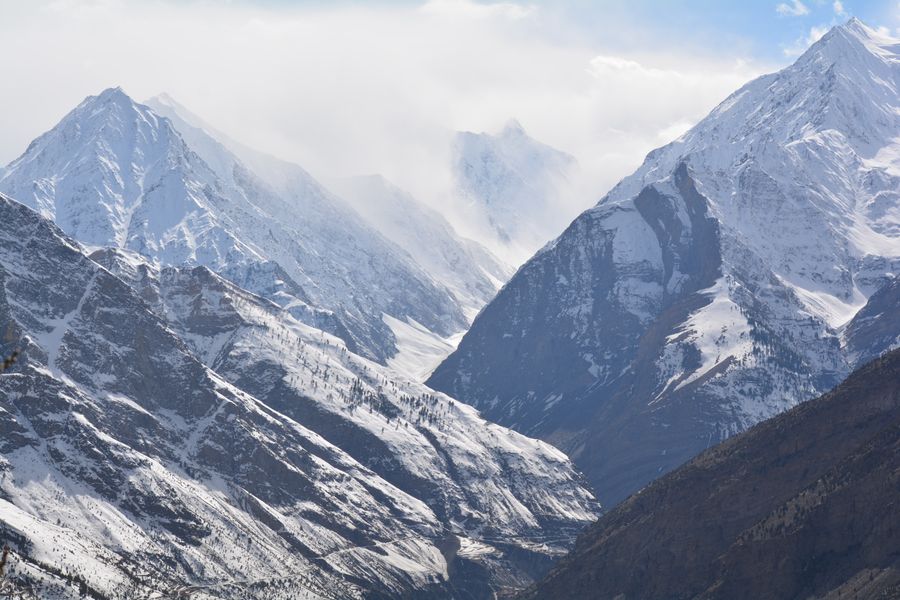
Main-line railways therefore aim at gradients that look almost flat to anyone standing beside them. A hillside that a road climbs directly is simply not available to a conventional train, which means the line has to find some way of gaining height slowly over a much greater distance than the map wants to allow.
There are three ways to do that. Wind along the contour, curve back on yourself repeatedly, or abandon adhesion and use a toothed rack rail that a locomotive can grip mechanically. India’s hill lines use all three, sometimes on the same route, and each of them costs speed.
Narrow gauge existed to make the curves possible
Several of the mountain lines were built to a narrower gauge than the main network, and the reason is geometric rather than economic. A narrower track can be taken round a tighter radius without the vehicle bodies overhanging awkwardly or the wheels fighting the rails, which means the line can follow the shape of a hillside more closely.
Cutting a narrower formation into a slope also moves far less material, needs shorter bridges and smaller tunnels, and can be built by hand in country where nothing larger could work. In the nineteenth century that difference decided whether a hill line was affordable at all.
The price is paid permanently. A narrow-gauge vehicle is smaller, carries less, cannot run onto the main network without transhipment, and rides less steadily at speed. These lines were never going to be fast, and everybody involved knew it when they were laid out.
Loops and zigzags are height-gaining machines
On some routes the line spirals over itself, crossing above its own alignment to gain height in a small area of hillside where a straight climb would be impossible. Elsewhere the solution is a zigzag: the train runs forward into a dead-end section, the direction is reversed, and it continues upward on a higher alignment.
Both are ingenious and both are slow. A spiral means you travel a long way to move a short distance up the valley. A reversal means stopping, changing ends and starting again, several times in a climb, with all the caution that shunting a train on a gradient requires.
Where adhesion alone would not serve at all, one Indian line uses a rack section, with a toothed rail between the running rails that a cogged wheel engages. It permits gradients no ordinary train could attempt, and it is slower still, because the mechanism has to be engaged and disengaged with care.
These lines are heritage first and transport second
Several Indian mountain railways carry international heritage recognition, which has shaped how they are maintained and presented. Original alignments, structures and in some cases rolling stock are preserved rather than replaced, and modernising them in the ordinary sense would defeat the purpose of keeping them.
That has consequences for travellers. Capacity is small, some services run only in certain seasons, and a road vehicle will beat the train comfortably on the same route. Nobody uses these lines because they are the quick way up the hill.
What they offer instead is the journey itself, at a pace that lets you look at the country, on an alignment chosen by engineers who had to negotiate with the terrain rather than blast through it. Whether that is worth several hours is a personal judgement, and for a lot of people it plainly is.
Booking and reliability need separate thought
Seats on the popular hill services are limited and go early, particularly in holiday periods, and some sections run as short tourist workings rather than as end-to-end journeys. The pattern of services on a given line changes, and it is worth checking what is actually running before building a day around it.
Weather closes these railways more readily than it closes roads. Landslips onto the formation, washouts under it and fallen trees across it all stop a train completely, and repairs on a narrow shelf cut into a hillside are slow. Suspensions of weeks are not unheard of after a bad monsoon.
The sensible approach is to treat a hill railway as something you hope to do rather than something the itinerary depends on. Have a road alternative in mind, book what you can in advance, and check the current position close to the date rather than trusting a timetable found online months earlier.
Common questions
Is the train quicker than the road?
Almost never. The road climbs directly and the railway takes a much longer alignment at a much lower speed, so the same journey typically takes several times as long by train. People take these lines for the journey, not to save time.
Do the hill railways run all year?
Most operate year-round in principle, but services are cut back in some seasons and suspended entirely after landslides or washouts, which are commonest during and after the monsoon. Check what is running close to your date rather than relying on a published pattern.
Which class is worth taking?
On short narrow-gauge lines the difference between classes is mostly about window position, seat padding and whether the compartment is enclosed. Since the view is the reason to be aboard, a seat with a clear window matters more than the class label attached to it.
Deputy editor, Traveology
Sofia writes the explanatory pieces on states, hills, coast & islands and reads the small print so you do not have to.