Hills
The people you meet on a high meadow live there for three months a year
Himalayan pastoralism moves flocks up and down the range on a fixed annual cycle, and most encounters between trekkers and shepherds happen because both are following the same short season.
By Leela Fernandes4 min read
Grazing in the mountains is a migration, not a location
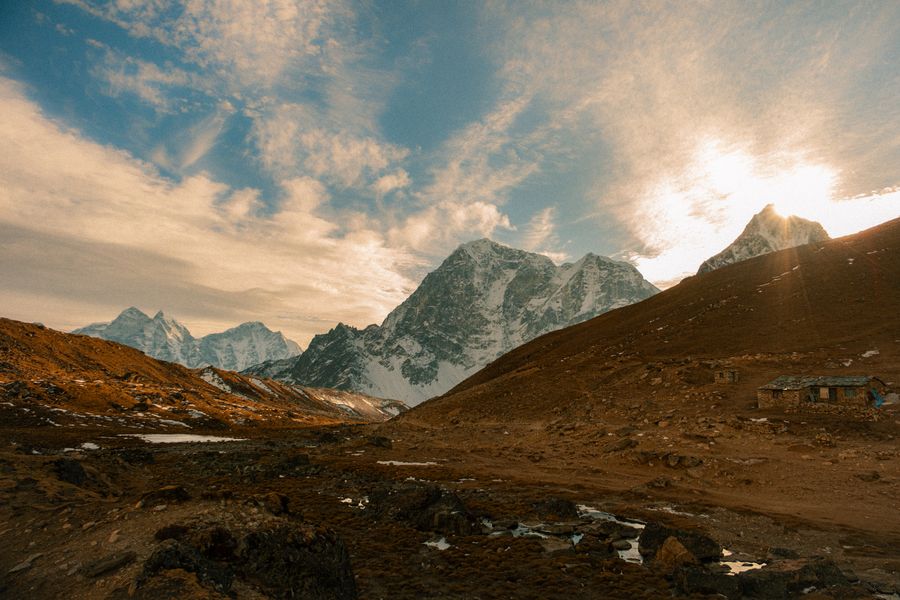
The high meadows of the Himalaya are only usable when the snow has gone, which leaves a short window in the middle of the year. The pastoral communities of the range solved that long ago by moving: winter in the lower hills or the plains edge, summer on the alpine pastures, and two long journeys between them each year.
The scale of these movements surprises people. Flocks of sheep and goats numbering in the hundreds are walked along established routes over passes, and the journey up may take weeks, with the households moving in stages as the grass becomes available behind the retreating snow.
That timing is the key to the whole system. Move too early and the pasture has not grown; move too late and the best grazing is gone and the descent risks early snow. The dates are read from the season rather than from a calendar, which is why the same route is busy in slightly different weeks each year.
Several distinct communities, several distinct systems
In the western Himalaya the Gaddi shepherds of the Chamba and Kangra hills take sheep and goats up over high passes into the inner valleys for the summer. Further north and west, Gujjar and Bakarwal households move with buffalo and with sheep respectively, along their own routes and to their own pastures.
In Ladakh and the high cold deserts the system is different again, based on pashmina goats and yak, with families moving between pastures within a high plateau rather than climbing out of a warm valley. The animals differ, the distances differ, and the products differ.
The eastern Himalaya has yak herding at the top end and mixed village grazing below it, but the compressed pattern is common to all of them: an intense summer of milk, wool and movement, followed by a long winter somewhere else.
The meadows are managed land, whatever they look like
A trekker arriving on an alpine meadow tends to read it as wilderness. It is grazing land with a long history of use, and often with allocated rights: particular pastures belong, by custom or by permit, to particular families or communities, and the arrangements can be centuries old.
The consequences are visible if you look. Stone shelters on a meadow are seasonal huts; a flattened area with old ash is a camp used every year; a network of narrow parallel paths across a slope is made by animals walking in file, not by walkers.
Whether grazing is good or bad for these meadows is disputed, and the answer is not the same in every valley. Moderate grazing has coexisted with the alpine flora for a very long time. Heavy concentration in a few accessible pastures, which is what happens when access to others is closed, is a different matter.
Meeting a shepherd camp on a trek
The camps are hospitable, often startlingly so given how little is carried up there, and tea is a normal offer. It is worth accepting, and it is worth having something to offer in return, though money is usually the wrong currency and is sometimes an insult.
The dogs are the thing to take seriously. Flock-guarding dogs in the western Himalaya are large, working animals whose job is to see off predators, and they will treat an approaching stranger as their problem. Give the flock a wide berth, let somebody call them off, and do not walk into a camp unannounced at dusk.
Ask before photographing people, and consider that a camp is a household, not a picturesque scene. If you are trekking with a local guide, the introduction happens naturally, which is one of the underrated arguments for having one.
The system is under pressure from several directions at once
Migration routes cross land that is now roaded, fenced, planted, built on or declared as protected area, and each of those makes the annual journey harder. Some traditional routes have effectively closed, and some households now truck their animals for part of the way instead of walking them.
Younger members of pastoral families increasingly take other work, which is an entirely reasonable choice and also a slow subtraction from a system that needs enough hands to move a flock safely. What replaces it is not obvious, since the meadows have no other productive use.
For a traveller, none of this changes what to do on the ground. But it does change how you might look at a camp on a high pasture. It is not a survival from the past put there for the view; it is a working arrangement operating under real strain, and this year’s presence on that meadow is not a guarantee of next year’s.
Common questions
Is it acceptable to camp near a shepherd camp?
Usually yes, with a little distance and after a word with whoever is there — it is their pasture, and the courtesy costs nothing. There are practical reasons to keep some separation too, mainly the dogs and the noise of a flock at first light.
Do the migrations follow fixed dates?
They follow the season rather than the calendar, so the weeks shift a little each year with the snowmelt. Broadly the movement upward happens as summer establishes and the descent begins before the first serious autumn snow, and local people will tell you where the flocks currently are far more accurately than any published account.
Can you walk with a migrating flock?
Some operators arrange this, and the experience is a genuine one when the family involved has agreed and is being properly compensated. It is not something to attach yourself to uninvited, since a moving flock is work under time pressure and an extra person who does not know the routine is a liability.
Features writer, Traveology
Leela writes about states, hills, coast & islands, mostly the parts other people skip and is happiest when a piece answers the question completely.