Hills
Old Himalayan villages sit above the river and the new towns sit on it
The settlement pattern in a mountain valley used to keep houses well clear of the water, and understanding why explains a great deal about where risk sits in the hills today.
By Leela Fernandes4 min read

Look up the slope and the old village is there
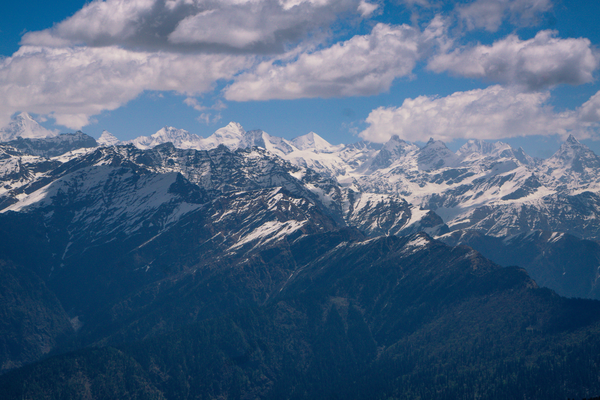
Travel any Himalayan valley by road and a pattern repeats. The road runs along the river, the market town sits beside the road, and several hundred metres above both, on a shelf or a spur, sits a cluster of older stone-and-timber houses with terraced fields below them.
That wasn’t an aesthetic choice. The high shelf had the spring, the sun, the workable soil and — crucially — distance from the river. A valley floor in these mountains is a place where water, rock and debris travel, and every generation that built up there knew it.
The modern arrangement inverted this within a few decades. Roads were built along the valley floor because that is where a road can be built cheaply, commerce moved to the road, and the buildings followed the commerce down onto the very ground the old villages avoided.
A mountain river is not a river most of the time
For much of the year a Himalayan stream is a modest ribbon of clear water in a very wide bed of boulders. That bed is the clue. The width of the boulder field, not the width of the water, records what the stream is capable of when it is loaded.
Discharge here varies enormously by season and by hour. Snowmelt rises through the day and peaks in the afternoon; monsoon rain in the catchment can arrive as a surge with no rain falling where you are standing; and a cloudburst — an intense, very localised downpour — can put an extraordinary volume of water into a small catchment in a short time.
What comes down isn’t only water. A charged mountain stream carries boulders, gravel and whole trees, and it is the debris rather than the flow that destroys structures. That is the mechanism behind the flood damage that recurs in these valleys, and it is why the bed is as wide as it is.
Recent history in these valleys has been instructive
The Himalayan states have had repeated flood and landslide disasters in living memory, with the Kedarnath valley events of 2013 the most widely reported. In several of these episodes the damage concentrated exactly where buildings had been put on the floodplain, the old riverbed and the debris fan at the mouth of a side stream.
Side-stream junctions deserve particular attention. A flat, convenient patch of ground at the point where a tributary meets the main river is almost always a debris fan built by that tributary, which is a record of the tributary doing this before. It is the most attractive building site in the valley and the least advisable.
This is contested ground politically. Development, road building and hydropower in the hills are argued over continuously, and the science on how much of the recent damage is attributable to construction as against extreme rainfall is genuinely unsettled. It would be dishonest to resolve that here.
Hydropower adds a scheduled variable to an unscheduled one
Many Himalayan rivers now have barrages and run-of-river schemes on them, and where they exist the flow downstream is partly managed. Levels can rise when water is released, and a stretch that has been a placid trickle for hours can change with limited warning.
Project operators generally use sirens and signage where the public has access, and the warnings should be treated as literal. The people most at risk from this are not travellers on the road but anyone who has walked out onto an apparently dry riverbed to sit, wash or photograph.
The general rule that follows is simple and applies whether the cause is a release, a cloudburst or afternoon melt. A dry gravel bed in a mountain valley is a channel, not a beach, and being on it is a bet on the next hour of a system you cannot see the top of.
What a traveller should take from the pattern
When choosing where to stay in a valley, the elevated older part of a town is usually on ground that has been proven over a long period, and a new building on the riverbank is on ground that has not. This isn’t a reason for alarm in ordinary conditions; it is a reason to think about it during heavy or prolonged rain.
During a serious rain event the useful instincts are to move up rather than along, to avoid crossing side streams that are running high, and to accept that a road may be cut in both directions for a while. Hill roads close from landslides as readily as from water, and waiting somewhere stable is almost always better than driving through it.
The last point is about the villages themselves. The high settlements are frequently the most interesting part of a valley to visit — older architecture, terraced fields, working temples and views that the road level does not have. Walking up to one is generally an hour of steep path and consistently the best hour of the day.
Common questions
Is it dangerous to stay in a riverside hotel in the hills?
In normal conditions, no. The risk is concentrated in extreme rainfall events and in the wettest weeks of the season. If you are travelling during heavy monsoon rain, ground level relative to the river is a reasonable thing to consider when choosing where to sleep.
What is a cloudburst?
An extremely intense, highly localised rainfall event, typically over a small area and a short period. In mountain catchments the runoff concentrates fast and arrives downstream as a surge carrying debris, which is why the damage can occur in places where it was not raining heavily at all.
Why do the roads follow the rivers if the valley floor is risky?
Because a river has already cut the only gradient a road can follow through the mountains, and building along the valley is far cheaper than any alternative. It is an engineering necessity rather than an oversight, and it is why so much hill infrastructure sits in exposed positions.
Features writer, Traveology
Leela writes about states, hills, coast & islands, mostly the parts other people skip and is happiest when a piece answers the question completely.